
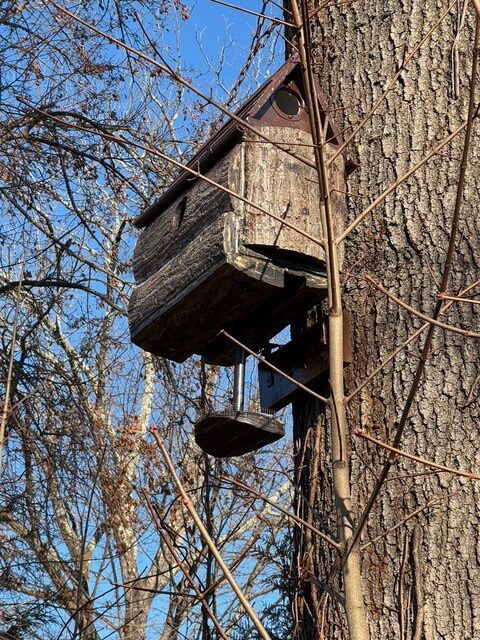
An Eastern Gray Squirrel (Sciurus carolinensis) crouches on the oak support beam directly above the frame of the SQRLBX camera feed. Outside the box, a gust sweeps through the hardwood upper story, rattling dry white oak leaves and sending small clusters of twigs swaying in wide, irregular arcs. The squirrel does not retreat. Instead, its posture tightens. It lifts its head, eyes fixed on the forest floor, and executes a crisp, rhythmic whipping motion with its tail—a snap of the plumy appendage that arches cleanly over its back, holds for a split second, and settles.
To a casual watcher on YouTube, the motion might look like simple nervous agitation brought on by the weather. But in animal communication, that sharp movement is a deliberate, visual alarm signal. When atmospheric conditions shift in the fall—bringing dropping barometric pressure, gusting winds, and erratic canopy movement—the ambient environment becomes visually and acoustically noisy. How tree-dwelling rodents navigate these mechanical disturbances to keep their visual telegraph readable is a classic problem in behavioral ecology.
Visual Noise in the Upper Canopy
In behavioral research published in Ethology, scientists studying animal communication have long examined how background movement interferes with visual signaling. When the forest is still, a sudden movement against a motionless backdrop of bark and leaves stands out clearly to neighboring conspecifics and ground-based predators. The sharp arc of a tail flick—what researchers distinguish from a longer, rolling tail “flag”—cuts through the background with high optical contrast.
When wind velocity increases, however, the entire background begins to move. Leaves flutter, small branches flex, and light dappling across the bark shifts constantly. In sensory ecology, this dynamic movement is known as motion noise. For a visual signal to register against a sway-filled canopy, the signal must differ in speed, amplitude, or frequency from the surrounding foliage.
According to research on multimodal communication in Sciurus carolinensis lead-authored by Thaddeus R. McRae in Behaviour, Eastern Gray Squirrels rely heavily on tail signals—including sharp twitches and sweeping flags—in tandem with acoustic vocalizations like “kuks,” “quaas,” and “moans” to broadcast threat levels. While vocal moans are strongly linked to aerial threats like raptors, visual tail flagging serves as a prominent alarm signal for ground threats, such as approaching predators.
When high wind speeds create erratic canopy motion, acoustic calls are easily muffled by the rushing air, while visual tail flicks risk blending into the general swaying of oak boughs. To overcome this environmental mask, the squirrel’s signal must cross an optical detection threshold.
The Aerodynamic Balance on the Limb
Tracking these shifts from the perch near the box reveals a physical trade-off that every Eastern Gray Squirrel must manage when autumn cold fronts move through.
A barometric drop typically signals an approaching frontal passage, bringing stronger wind gusts and sudden shifts in direction. On a calm morning, a squirrel sitting on a horizontal limb can execute a full, exaggerated tail flag with minimal risk to its balance. The tail acts as a counterweight, but the energetic cost and physical torque required to move it are easily managed when the perch is stable.
In gusty conditions, the perch itself is moving. A 15-knot breeze flexes an oak branch, forcing the squirrel to use its claws and hind-leg muscles continuously just to stay anchored. Under those conditions, throwing a large, rolling tail flag adds significant drag and destabilizes the body.
Observers watching the live stream often see the squirrel adapt to this mechanical reality by modifying its display. Rather than deploying wide, sweeping tail flags that catch the wind, the animal shifts toward shorter, high-velocity tail twitches. These rapid, localized flicks create high acceleration at the tip of the tail, generating a crisp visual signal that stands out against the slower, broader swaying of heavy branches without catching enough wind to knock the squirrel off balance.
Multimodal Signaling Under Pressure
The Eastern Gray Squirrel’s alarm system is fundamentally multimodal, drawing on both sight and sound to deliver a clear message. Research published in Ethology Ecology & Evolution demonstrates that gray squirrels adjust the composition and delivery rate of their alarm signals depending on the nature of the threat and environmental conditions.
When shifting weather alters the physical environment, it changes how those visual and auditory components perform:
- Calm Air, High Visibility: Acoustic calls carry cleanly through the quiet timber, and short tail twitches provide unambiguous spatial verification to nearby squirrels.
- Elevated Wind, High Motion Noise: Wind noise muffles acoustic calls while background branch movement obscures subtle tail twitches, forcing the squirrel to rely on high-contrast, sharp-amplitude tail snaps during lulls between major gusts.
- Barometric Drops and Frontal Wind: Fast-moving air currents demand low drag, leading the squirrel to stay closer to main tree trunks or heavy beams, where branch displacement is minimal and footing remains secure.
Watching this unfold over hours on the stream offers a quiet lesson in functional adaptation. The squirrel perched on the SQRLBX beam is not reacting blindly to the wind. It is constantly adjusting its stance, measuring the sway of the timber, and tuning its visual signals so that when a genuine threat appears, its message cuts through the autumn noise.
Subscribe to SQRLBX on YouTube | https://www.youtube.com/@SQRLBX