
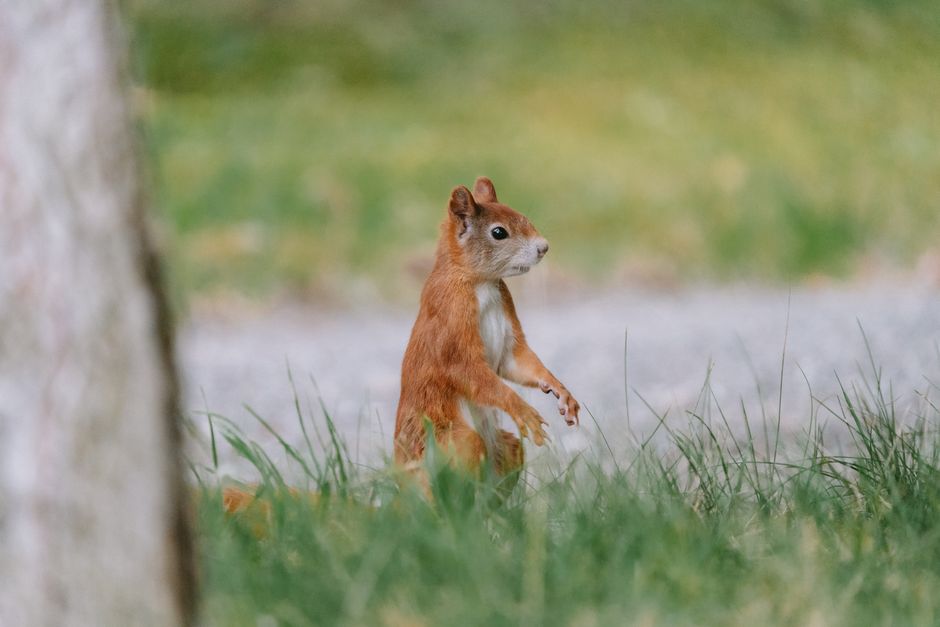
Urban wildlife writing loves a tidy story: city life selects for bold, chatty, people-tolerant animals. A study tracking red squirrel behavior across the urban-to-rural gradient says that story is only half right — and the half that’s wrong is the interesting half.
What actually moved
Personality in animal behavior research usually gets sorted into a handful of stable axes — boldness, activity, sociability, aggression, exploration — the same framework Health Aggarwal and colleagues have used for decades in the “animal personality” literature to argue that individuals, not just species, have consistent behavioral styles across contexts. The assumption baked into a lot of pop-science coverage of urban wildlife is that all of these axes shift together as animals move into denser, human-saturated habitat: bolder, louder, more social, all at once, like a single dial turned up.
That’s not what the data show here. Vocalization rates and social tolerance — how often squirrels called, how close they tolerated conspecifics, whether they foraged in loose aggregations — stayed flat across the gradient. What tracked with urbanization instead was a narrower behavior: proximity tolerance to humans and human infrastructure. Squirrels in built-up sites didn’t become more gregarious animals. They became animals more willing to forage, cache, and move through space with a person standing closer than a rural squirrel would ever allow.
That distinction matters because it’s easy to conflate “bold near people” with “generally more outgoing.” A squirrel that lets a jogger pass six feet away isn’t necessarily the same animal that would tolerate a rival at its cache site, or that calls more from a perch. Those are different circuits, and this study is one of the first to pull them apart cleanly along a single gradient rather than comparing separate urban and rural populations in isolation.
Why this contradicts the “urban syndrome” story
The convenient version of urban wildlife adaptation treats boldness as a package deal — animals either have the “urban personality” or they don’t. Coyotes get less shy, gulls get more aggressive at food, and the assumption trickles down to squirrels: city squirrels beg at benches, rural squirrels flee at forty yards, ergo city squirrels are just bolder animals across the board.
What this framing misses is habituation versus temperament. An animal can learn, within its own lifetime, that a specific stimulus (a human at ten feet, a food wrapper, a bench) doesn’t predict danger, without any underlying shift in its baseline vocal or social tendencies. That’s habituation — a context-specific update — not a personality trait. Treating the two as interchangeable is exactly the kind of category error that makes “urban wildlife gets bolder” read as a settled fact rather than a claim that needs the axes separated before you can say anything precise.
Field notes on what this looks like in practice
Watch a red squirrel work a cache near a trailhead versus one working a cache fifty yards into unmanaged forest, and the difference isn’t in how much either one chatters at a rival two trees over — it’s in how long each one keeps an eye on you before committing to bury the acorn. The trailhead squirrel clips the pause short. The forest squirrel doesn’t. Tail-flagging, the classic alarm signal red squirrels give when a threat is close but not immediate, shows up in both populations at similar rates when a genuine conspecific or predator threat is present — it’s the threshold for what counts as threatening that’s shifted, not the signal repertoire itself.
That’s consistent with what this study is describing: a recalibrated risk threshold specific to human proximity, layered on top of an otherwise stable personality profile. The squirrel isn’t a different animal in the city. It’s the same animal, running a different lookup table for one specific stimulus.
The overrated takeaway, and the useful one
The overrated version of this finding, if you’re reading headlines instead of the paper, is “science proves city animals are just fearless now.” That’s not what a single-axis shift supports, and treating boldness as a monolithic trait that scales with urbanization is exactly the imprecision this research pushes back against.
The useful takeaway is narrower and more practical for anyone doing backyard or park observation: don’t use “how close will it let me get” as a stand-in for “how social or vocal is this animal.” They’re not the same measurement, and conflating them will lead you to misread individual animals — the squirrel tolerating your presence at a feeder isn’t necessarily the most socially confident animal in the population, just the one with the lowest threshold for treating you as a non-threat. If you’re logging behavior at a stand or a stream cam, that’s worth tracking as two separate columns, not one.
Subscribe to SQRLBX on YouTube | https://www.youtube.com/@SQRLBX