
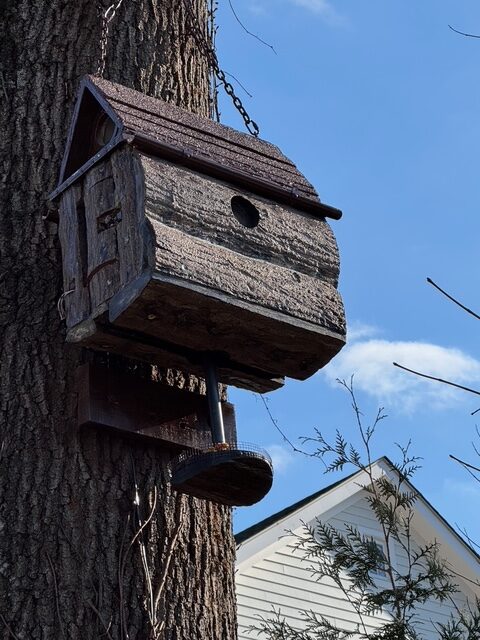
At 7:14 this morning, a squirrel on the box sat up on its haunches, turned an acorn over twice like it was checking for a price tag, and buried it four inches from where it had buried the last one. Chat, predictably, lost its mind. Someone typed “HOARDER,” someone else typed “he’s fine, he’s rich,” and then the conversation did what it always does around this time of year — it turned, gently, from cute to actually curious. Why so many acorns. Why now. Why does he look, if you squint, a little rounder than he did in August.
The rounder part is not sentimental. It is the whole plot.
Eastern gray squirrels do not hibernate. They tough out winter awake, which sounds worse than digging a hole and sleeping through it, but it comes with an advantage: they can eat their way through the cold instead of just outlasting it. The biologist Bernd Heinrich, who has spent much of his career studying how animals survive winter without checking out of it, has written about “shivering thermogenesis” — the trick of generating heat by contracting muscle, on purpose, as a kind of internal space heater. It is expensive. Heinrich’s work on winter physiology, most fully laid out in his book Winter World, describes how small mammals that stay active through cold months have to burn fuel almost continuously just to keep their core temperature out of danger — and fuel, for a squirrel, mostly means fat, and fat mostly means acorns.
This is the part of the season the chat has started calling, only half-joking, “acorn season proper.” Not the eating-in-the-open acorns of August, which get gnawed on camera in full view and gone in ninety seconds. The autumn acorns are different. They get carried off. They get buried in a shallow pocket the squirrel presses shut with its nose, in a spot it will supposedly remember later by scent — a behavior known as scatter-hoarding, in which food is spread across dozens or hundreds of small caches rather than one big pantry, so that a single raid by a jay or a rival squirrel cannot wipe out the whole winter’s budget at once.
The Chat as Ledger
What makes this a good week to be watching, rather than just a nice one, is that the community has more or less appointed itself an accounting department. Regulars keep informal tallies in the chat log — not exact counts, nobody’s pretending to run a spreadsheet, but a running sense of tempo. Is he burying more than he’s eating today. Did he come back to check a cache he made yesterday. Is that a white oak acorn or a red oak acorn, because — and this is the kind of detail that turns lurkers into regulars — white oak acorns germinate almost immediately and don’t store as well, while red oak acorns stay dormant longer and keep through winter, so a squirrel with any sense buries the reds and eats the whites fresh. Nobody in chat learned that from a syllabus. They learned it from watching the same squirrel make the same choice, over and over, until the pattern became obvious enough to name.
There’s a rhythm to the burying that the long-timers notice before newcomers do: a lot of short trips low to the ground in the early morning cold, a slower midday when the sun’s out and the squirrel seems, if you can say this about a rodent, unhurried. Heinrich’s broader point about winter survival — that endothermic animals are essentially always solving a heat-versus-fuel equation, and every behavioral choice bends toward that equation — plays out on the box in miniature. The squirrel is not performing industriousness for an audience. It is running arithmetic it cannot afford to get wrong.
What the Shiver Buys
Here is the arithmetic, roughly, as Heinrich describes it in Winter World: a body that shivers to stay warm is spending calories to make heat instead of spending them on anything else, and it can only sustain that spending if the calories keep arriving. An empty cache in February is not an inconvenience. It is the whole strategy failing at the moment it matters most. So the September squirrel — plump, busy, faintly ridiculous with its cheeks — is not hoarding out of greed. It’s building the account balance that the January squirrel will draw down, one shiver at a time, through nights the chat will never see because most people are asleep by then too.
That’s the part that tends to land with viewers who’ve stuck around a few seasons: the calm everyone comes to watch in July has a bill attached, and autumn is when it gets paid. Someone in chat put it more plainly than any of this — just “he’s not hoarding, he’s paying rent in advance” — and then the squirrel buried one more acorn, checked the spot with its nose, and moved four inches over to start again.
The cold hasn’t arrived yet. The ledger has.
Subscribe to SQRLBX on YouTube | https://www.youtube.com/@SQRLBX