

An Eastern Gray Squirrel (Sciurus carolinensis) sits motionless on a sunlit fork of an oak limb, motionless except for the slow, rhythmic puff of its breath against the chill air. Down on the forest floor, the grass is heavy with white frost, but thirty feet up, where the early light strikes the upper canopy, the wood is warm to the touch.
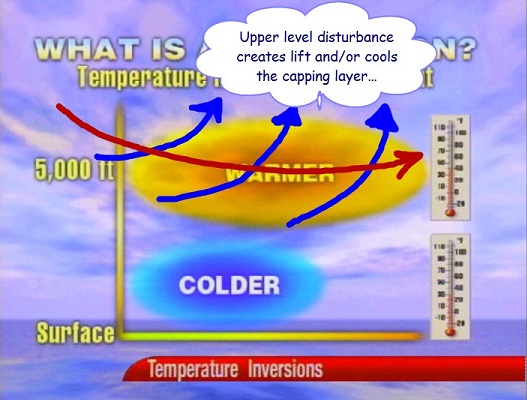
On autumn mornings under clear skies, the ground cools rapidly through radiational cooling. As heat escapes into space, a thin layer of cold air becomes trapped beneath a warmer air layer, forming a shallow thermal inversion. Without wind to mix the atmospheric boundary layer, scent particles and moisture remain stagnant near the ground. This phenomenon temporarily alters the early morning behavior of resident Eastern Gray Squirrels.

The Microclimate of the Upper Canopy
During radiational cooling events, the Earth’s surface emits longwave radiation faster than it absorbs incoming energy, creating a sharp temperature gradient between the ground and the mid-canopy. According to the National Weather Service, these nocturnal inversions develop under calm winds and clear skies, trapping stagnant air near the earth’s surface until solar heating destabilizes the lower boundary layer later in the morning.
While ground-level air remains chilled, sunlight strikes the upper oak branches first, warming the wood and the immediate surrounding microclimate. Eastern Gray Squirrels emerging from their nests utilize these elevated, warmer zones rather than immediately descending to the colder, dew-laden forest floor. The upper canopy acts as a warm thermal pocket while ground temperatures remain locked in the inversion layer.
Olfactory Stagnation and Foraging Shifts
The absence of vertical air movement under a shallow inversion limits scent dissipation along the ground. For Eastern Gray Squirrels, which rely heavily on olfactory cues to relocate buried acorns and hickory nuts, cold ground temperatures and stagnant air make ground foraging less efficient during the earliest daylight hours.
By remaining in the upper canopy, squirrels focus their morning activity on searching for intact acorn clusters, clipping twigs, or basking in direct sunlight to regulate body temperature. Observations around the camera box demonstrate that ground activity resumes only after surface air warms sufficiently to break the thermal inversion layer, triggering micro-updrafts that carry scent currents through the understory.
Morning Atmospheric Breakout
As the morning progresses, solar radiation heats the ground surface, eroding the base of the inversion. Convective air currents begin to rise, mixing the warmer upper air with the cool air trapped below. This mechanical mixing dissipates the ground fog and dew, allowing air currents to move freely through the leaf litter.
Once this atmospheric breakout occurs, Eastern Gray Squirrels shift their behavior, descending the trunks to begin active ground foraging. Tracking these daily microclimatic shifts offers insight into how fine-scale weather patterns directly influence arboreal wildlife routines.
Live views of Eastern Gray Squirrel activity are available around the clock at www.SQRLBX.com and on YouTube as SQRLBX.
Subscribe to SQRLBX on YouTube | https://www.youtube.com/@SQRLBX